

American researchers are using X-rays to understand the flaws in batteries that use fast charging technology.
While car fuel tanks fill up in minutes, electric car batteries take a long time to charge. To prepare the market for greater interest in electric vehicles, scientists are working hard to develop fast-charging battery technology.
Batteries are among the most important sources of livelihood in our time, and they are divided into two main types: rechargeable batteries, such as those used in mobile phones, laptops, and cars, and non-rechargeable batteries, in which the chemical reaction occurs only once and in one direction, such as those used in wall clocks or hearing aids for the hearing impaired.
Despite their different technologies and uses, both types share a similar chemical composition. Scientists have developed numerous batteries using various metals: lead-acid batteries, zinc-carbon batteries, mercury batteries, and nickel-cadmium batteries. Recent decades have seen a surge in the development of lithium-ion batteries , which can be used as a sustainable power source in electric vehicles.
Researchers from Argonne National Laboratory in the United States published a study in the journal “Energy and Environmental Sciences” exploring the possibility of using X-rays to identify shortcomings in lithium batteries during operation and fast charging.
“The charging speed of batteries in general, and electric vehicle batteries in particular, is critical, as we aim to reduce charging time to fifteen minutes or perhaps less,” said Daniel Abraham, the research team leader, in a statement to the newspaper. He added, “By observing the path, distribution, and diffusion of lithium ions within the battery electrode, we have the opportunity to identify entirely different causes of lithium battery aging during fast charging.”
The internal structure of the battery consists of four parts: two electrodes, one positive and the other negative, separated by a permeable membrane, immersed in an electrolyte solution, which is any substance containing salts and ions dissolved in water, and whose function is to stimulate the transfer of ions between the two electrodes, i.e., to conduct the electric current.
Daniel explained: “During battery charging, lithium ions move from the positive electrode (lithium) to the negative electrode (graphene), and this process is reversed during battery discharge in any use.” He added: “The problem with fast charging technology is the speed of ion transfer between the electrodes, which leads to consumption during charging and discharging. We found that most of this consumption is near the membrane separating the electrodes, not the battery terminals.”
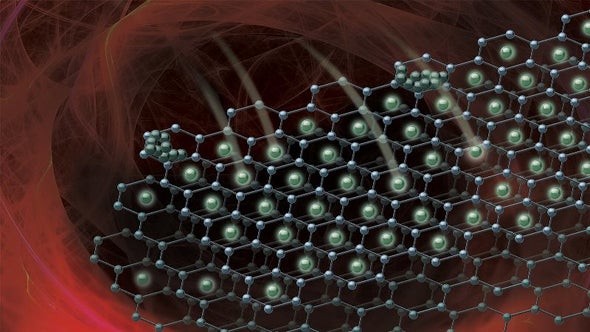
Daniel explained that “in slow charging, the lithium ions emitted from the anode gradually move and settle between the layers of carbon (graphene) stacked on top of each other, in a process called ‘lithium interpenetration.’ In fast charging, however, the lithium ions are deposited on the graphene surface as a metallic substance, a process called ‘lithium plating.’ The lithium plating of the negative electrode prevents the ions from interpenetrating between the carbon layers, thus significantly reducing the battery’s efficiency.” In this case, the ions cannot move smoothly between the electrodes.
In “Daniel”, the lithium metal accumulates on the surface of the graphene, which chemically affects the electrolyte, reducing it to a solid state, thus hindering the movement of lithium ions, and over time the battery retains less energy inside it.
When Daniel was asked whether it would be possible to add a chemical to the battery to prevent lithium from accumulating on the graphene to avoid the plating process, he replied: “No substance can be added to the battery components, because that would change the properties of the electrochemical analysis, and would not replace the lithium plating process.”
It is worth noting that one method of coating different objects is done in a manner similar to the idea of a battery; where the coating ions move from the positive electrode to the negative electrode to settle on the object.
To study the movement of lithium ions inside fast-charging batteries, the researchers used X-rays. To see a specific area at the heart of the battery, the researchers used a technique called “energy-scattered X-rays” to capture two-dimensional images of the lithium-coated graphene, and discovered that the places where the metals are deposited are located near the membrane that separates the electrodes.
John Ansens, the second researcher, said, “We relied on changing the wavelength of the X-rays to determine the crystal structure of graphene because it is a crystalline material with a unique atomic arrangement; its atoms form a hexagonal, honeycomb-like structure.” He added, “Instead of changing the angle of incidence, both methods are used to measure the crystal structure of graphene according to Bragg’s equation, but changing the wavelength with energy allows the rays to penetrate the outer metal of the battery more easily.”
He said: “The entry of lithium between the layers of graphene causes it to expand. Its crystalline lattice structure expands to varying degrees. This is where the role of X-rays scattered by this expansion comes in.”
“This study is good, but what we’re waiting for is to find ways to make fast charging technology effective and safe,” said Stanley Whitnam, a professor at Binghamton University in New York and founder of rechargeable lithium batteries.
Yang Horn, a researcher and professor of energy at MIT, said: “The results of the study are extremely important and very useful because they offer new insights into addressing the challenges of fast charging technology using possible strategies.”
“We don’t have solutions at the moment, but we are currently working on new research that we hope will lead to fast, efficient and safe battery charging,” Daniel said after Stanley’s comment.
John Onsens said: “Our focus in this research is on button batteries, but we are working hard to apply this research to large-scale batteries, such as smartphone batteries and electric car batteries, to study the behavior of lithium.”
Daniel says: “There are three proposals by which we can reduce the rate of lithium deposition on graphene (lithium coating): designing an electrode that allows for faster diffusion of lithium ions, using graphene which allows lithium ions to be inserted between its layers very quickly, and finally charging the battery at slightly higher temperatures, for example at 45 degrees Celsius.”
0 Comments