

Superhuman abilities, often depicted in science fiction films, may soon become a reality after a team of American researchers helped a group of experimental mice see near-infrared light using nanoparticles. Further development of this technology is expected to enable people to see at night as if they possessed superhuman eyes.
“When we look at the universe, we only see visible light,” says Zhang Han, the lead researcher on the project, whose findings were presented at the American Chemical Society conference in late August. This light has wavelengths between 400 and 700 nanometers, but if we could see infrared light with longer wavelengths (between 750 nanometers and 1.4 micrometers), we would see the universe differently, and we would be able to see at night without needing bulky instruments.
“Thermal imaging cameras allow people to see in the dark by detecting near-infrared radiation emitted by living beings and objects.”
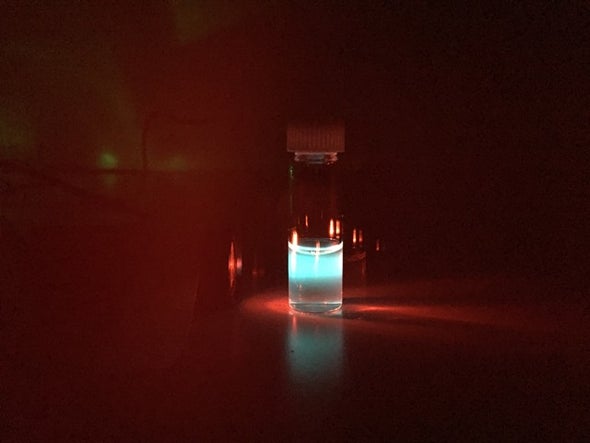
Researchers at the University of Massachusetts Medical School injected nanoparticles containing rare-earth elements such as erbium and ytterbium, converting low-energy infrared photons into a bright green light visible to mammals. These particles were directed at the photoreceptors in the retinas of mice.
To determine whether the mice in the experiment could mentally see and interpret infrared light, the researchers conducted several psychological and behavioral tests. For example, the mice were placed in a Y-shaped water tank with a platform at one end that they could climb onto to get out of the water.
The researchers trained the mice to swim towards a visible light in a triangular pattern (the escape route). A bright circle was placed in a branch of the water tank, which did not have an escape platform, and the researchers replaced the visible light with infrared light.
Han says: “The mice whose eyes were injected with nanoparticles were able to see the triangle clearly and swim towards it every time. The remaining mice could not distinguish between the shape of the triangle and the circle.”
Han said: “Although these nanoparticles persisted in the eyes of mice for ten weeks without significant side effects, we are seeking to improve the safety and sensitivity of these particles before testing them on human eyes, and we still need to improve the illumination of these particles before using them on humans.”
The research team is currently experimenting with molecules made from two organic dyes instead of earth elements, enabling them to emit green or light blue light. Organic dyes would face no regulatory hurdles; they have already been used in clinical trials and have more established standards. Testing this technology on dogs is expected in the near future.
Han says, “Beyond the idea of superhuman abilities, this technology could have important medical applications in treating certain retinal diseases, such as dry age-related macular degeneration, a common eye disorder affecting adults over 50.” This disease causes blurred or impaired central vision due to thinning of the macula, the layer of the retina responsible for light transmission, resulting in distorted vision in straight lines. These nanoparticles also hold great promise for applications in bioimaging and exploratory sensors.
0 Comments