

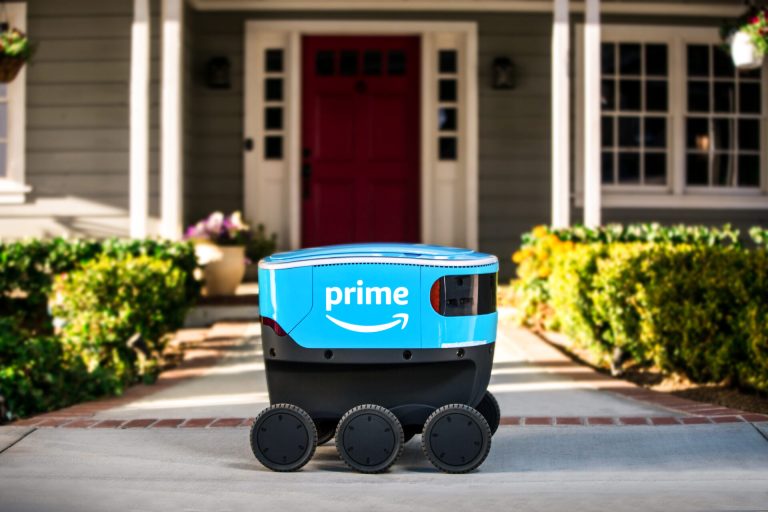
Earlier this year, six
Amazon Scout delivery robots were launched in a pilot program in Snohomish County, Washington. These six-wheeled, icebox-like robots delivered meals, groceries, and packages to homes and offices in that area north of Seattle. They join a small but growing number of robots slowly making their way along the sidewalks of London, Beijing, and other cities and communities around the world. As they move, these robots encounter numerous pedestrians, curious dogs, and cracked pavements, raising an important question: Why are companies investing in delivery robots in the first place?
These services are gaining momentum as an increasing number of city dwellers rely on delivery services to receive most of their orders, either immediately or on time. Between 2016 and 2017 , online retail sales in the United States rose by 16% . Food delivery companies are gaining popularity, and online grocery sales are also experiencing significant growth. In the final stage of delivery, known as the “last mile,” packages are typically transported by people using bicycles, scooters, or large delivery vans. These vehicles contribute to the already congested city streets. “Delivery services continue to grow in all densely populated urban centers,” says Paul McKee, director of research and communications at the Mobility Lab, a transportation policy research center in Arlington, Virginia. “If city and state leaders don’t start thinking about innovations like delivery services, we’ll face even worse traffic jams with the introduction of robots, as we all try to get to our destinations.”
A study by the Mobility Lab and George Mason University revealed that 73% of delivery trucks in Arlington were parked outside designated parking spaces, often obstructing bike paths and pedestrian crossings, and blocking access to fire hydrants. Therefore, according to McKee, by moving the final stage of these deliveries from the road to the sidewalk, cities can reduce traffic congestion and ultimately eliminate the problem of delivery trucks parking outside designated spaces.
But the goal of companies like Amazon in developing this delivery technology isn’t limited to eliminating traffic congestion. According to a 2018 report by McKinsey & Company in New York, self-driving vehicles and sidewalk-based robots could reduce delivery costs in cities by up to 40% . While manufacturing a single delivery robot costs thousands of dollars, most of which currently require human supervision and maintenance, in the long run, companies that prove their capabilities in the field of autonomous delivery vehicles could save billions of dollars in the coming years, the report states.
To gain public trust, these machines must prove their ability to safely share pedestrian spaces with humans, without obstructing or inconveniencing them. Some American cities have nearly empty streets and sidewalks, where pedestrians may not pass for hours. These streets and sidewalks are capable of accommodating robots, says Renya Ehrenfoecht, chair of the Department of Community and Regional Planning at the University of New Mexico at Albuquerque and co-author of “Sidewalks: Conflict and Negotiation in Public Space.” But as sidewalks become increasingly congested, even fast-moving robots will face challenges, and these challenges will be exacerbated in American cities with narrow sidewalks. “It’s really hard to move smoothly across crowded sidewalks without bumping into people,” Ehrenfoecht adds. “Until delivery robots reach a high level of proficiency, they will obstruct people’s movement if they can.”
Sidewalk delivery robots may encounter some obstacles, including curious passersby who obstruct their path and thieves attempting to steal packages during delivery. The latter problem can be mitigated using remotely controlled package-sealing mechanisms. But there are numerous examples of other challenges, such as a video released last year showing a delivery robot temporarily disabled after children covered its cameras and sensors with snow. There’s also the social experiment of the Canadian robot Hitchbot, which traveled across Canada and Europe before being decapitated in Philadelphia at the start of its U.S. tour. Mary Cummings, director of the Human and Autonomous Control Lab at Duke University, says, “I really think the biggest problem will be either pranks or outright malicious behavior.”
But Starship Technologies, based in San Francisco and Estonia, is more optimistic. Hundreds of the company’s robots have completed 25,000 deliveries, navigating residential neighborhoods using machine learning, sensors, and digital maps. “Most people who share sidewalks with our robots barely notice them, and when they do, it’s mostly a positive thing,” says Ryan Tuhey, senior vice president of business development. “After our robots have been in an area for a while, people get used to them. The robots become part of the community, and residents are concerned about their safety.” These robots operate almost entirely autonomously within mapped areas but are remotely monitored by human operators who can intervene when necessary. Even so, Starship Technologies itself has acknowledged that some people occasionally kick its $5,500 robots as they pass by.
Other challenges include perfecting the software design that helps delivery robots avoid stationary and moving objects, and dealing with city officials who want to protect public spaces. For example, San Francisco—home to startups like DoorDash and Postmates—imposed a sudden ban in 2017 on self-propelled curbside robots, and companies seeking permits were restricted to operating at a very slow pace. Other U.S. communities have also introduced regulations governing where and how these robots can operate.
Given these obstacles, robots may not dominate sidewalks in the future. That’s why Nuro, a startup founded by two former Google employees, has developed the R1, a self-driving vehicle designed to navigate streets rather than sidewalks. This vehicle joins the company’s existing fleet of self-driving Toyota Prius cars, which have already completed nearly 1,000 grocery deliveries in Scottsdale, Arizona, since mid-December 2018. Drones face their own challenges, but they have the potential to provide broader services in underserved rural and suburban areas.
Ultimately, the best solution to this surplus may lie in delivery vehicles outside the realm of technology. A 2016 McKinsey & Company report indicated that older bicycles remain the most cost-effective option for the final stage of many deliveries. The firm’s analysts wrote, “If the cost of robots doesn’t decrease significantly, cyclists may become the preferred means of instant delivery in urban areas.”
0 Comments